How to Find a High-Quality Meme Coin Entry in 2026 Without Chasing the Pump
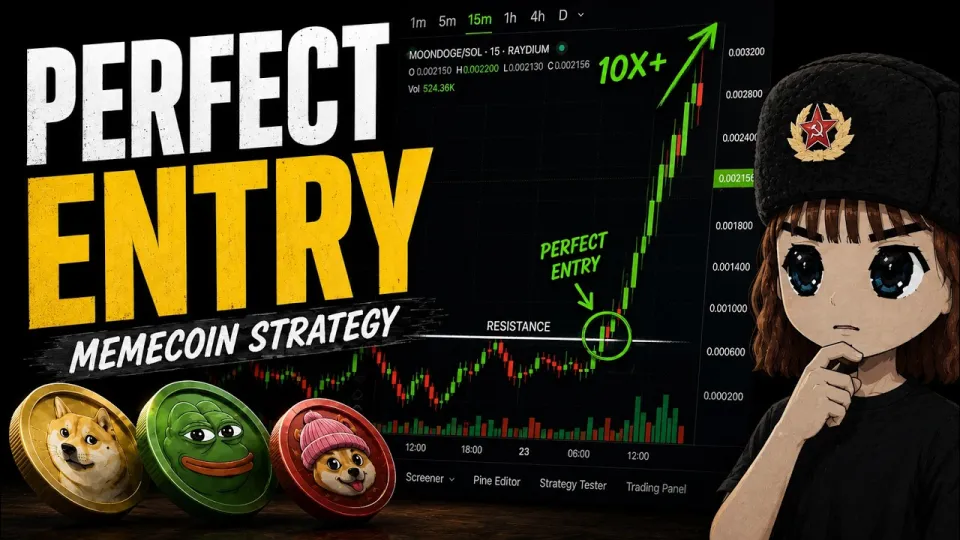
Video: How I Find the PERFECT Entry on Memecoins 📈 (Full Strategy)
Need articles like this for your video? They help promote it on YouTube and Google — order them in the Telegram bot @sat_sit_bot. It writes articles around your video, embeds the video and publishes them on popular niche websites (no ads). Try it free: 50 articles on us.
· based on the channel starwifpump
Key takeaways
- Most meme coin losses come from timing entries, not from picking the wrong ticker.
- Chasing green candles and FOMO buying destroys the risk-to-reward before the trade even starts.
- Pullbacks to support and momentum confirmation are the two core entry filters.
- Invalidation signals and pre-planned exits are set before the position is opened.
- Tools such as Plasma and Axiom are used for execution and position tracking.
A meme coin entry is the price level and confirmation at which a trader opens a position after the chart has already shown momentum, a pullback and a defined invalidation point. The edge does not come from predicting every move but from a repeatable process: wait for the setup, size the risk, and let the chart tell you when to stay out. The full breakdown of this approach comes from the starwifpump video "How I Find the PERFECT Entry on Memecoins (Full Strategy)", and the author's Plasma Telegram for early access and setup help is available here: join the Plasma Telegram for early access.
Why meme coin traders lose on timing rather than on coin selection
Most meme coin traders do not lose because they picked the wrong coin; they lose because they entered at the wrong time. A token can be a genuine narrative leader and still produce a losing trade if the buyer pays the top of a vertical candle. The chart does not care how good the story is — it only cares where your entry sits relative to support, liquidity and the crowd's average cost.
Three timing mistakes repeat across almost every losing meme coin trade:
- Buying the third or fourth consecutive green candle, when the move is already extended and the nearest support is far below.
- Entering without a level that would prove the idea wrong, which turns a trade into a hold-and-hope position.
- Sizing up because the chart looks obvious, which converts a normal pullback into an account-ending event.
On Solana-style meme coins, where a token can print a 300% move in minutes and give back half of it just as fast, entry price is the single largest variable in risk-to-reward. A 20% better entry can double the reward-to-risk ratio of the same trade with the same exit.
The pre-entry chart checklist before any meme coin buy
A meme coin chart should be read in a fixed order before any order is placed, so the decision is mechanical rather than emotional. The checklist below is the one that separates a planned entry from a reaction to a green candle.
- Structure: is the token making higher lows, or is it a single vertical spike with no base? A base gives you something to measure risk against.
- Liquidity and volume: thin volume on a new launch means slippage and fake breakouts; rising volume alongside rising price is confirmation, falling volume into a new high is a warning.
- Holder distribution and contract checks: concentrated supply or a suspicious contract setup invalidates the chart entirely, no matter how clean the pattern looks.
- Narrative timing: is the coin early in its story or on day three of a trend that every account already posted about?
- Reference levels: mark the launch price, the first consolidation zone and the most recent higher low before you look at the current candle.
If any of these checks fails, the correct action is to skip the trade. Missing a runner costs nothing; entering a structurally broken chart costs capital.
How to identify momentum without chasing the pump
Momentum is confirmed by a sequence, not by a single candle. The healthy pattern is an impulse move, a pause, and a continuation — and the entry belongs in the pause, not in the impulse. Chasing means buying when price is far from any level that could support it, which leaves no room for a stop and no margin for error.
A practical way to avoid chasing:
- Wait for the first impulse to finish and for the chart to print a short consolidation or flag.
- Check that volume contracts during the pause and expands again on the breakout attempt.
- Enter on the reclaim of the consolidation high, or on the retest of that level after the breakout.
- If price is already more than a set distance above the last higher low, treat the setup as gone and wait for the next one.
This is the difference between buying strength and buying extension. Strength has a defined risk point underneath it; extension has only air.
Using pullbacks and support levels to improve entries
Pullbacks are where entry quality is actually created, because they let a trader buy closer to the level that invalidates the idea. A pullback entry on a meme coin usually means waiting for price to return to a previous breakout zone, a consolidation floor, or a moving average that has already acted as support on the same chart.
A repeatable pullback process looks like this:
- Identify the level where buyers previously stepped in and where the last consolidation broke out.
- Wait for price to come back to that zone rather than buying the first touch of a new high.
- Look for a reaction: a wick into the level with a close back above it, or a higher low forming on a lower timeframe.
- Place the invalidation just below the level, so the stop distance is small and the position size can be larger for the same dollar risk.
The result is a better risk-to-reward on the identical trade idea. The same coin, the same target, but a stop that is 10% away instead of 40% away changes the entire math of the position.
Red flags that say do not enter
A no-trade signal is as valuable as an entry signal, and several chart conditions should automatically cancel a meme coin buy. Recognizing them in advance removes the temptation to talk yourself into a position.
- Price is extended far above the last support with no consolidation, meaning any stop is too wide to justify the trade.
- Volume is fading while price grinds higher, a classic divergence that often precedes a sharp reversal.
- The token has already printed a blow-off top and is now making lower highs.
- Liquidity is thin enough that a normal-sized order would move the price significantly.
- The narrative is already fully priced in and the chart depends on one more wave of hype to continue.
In each case the correct outcome is patience. A trader who skips ten mediocre setups and takes one clean pullback is usually ahead of the trader who takes all eleven.
Planning risk, exits and profit-taking before the trade
Risk is planned before the entry, not after the position turns red. The sequence is straightforward: define the invalidation level from the chart, decide the maximum acceptable loss on the trade, then calculate position size from that distance. If the resulting size is too small to be meaningful, the setup is not good enough to take.
A workable template for meme coin trades:
- Set invalidation below the pullback low or the consolidation floor, whichever is structurally relevant.
- Cap the loss per trade at a fixed small percentage of the portfolio, so a series of losses never becomes fatal.
- Take partial profit at the first obvious resistance or at a predefined multiple, and move the stop to break-even after the first scale-out.
- Leave a runner only if the chart still shows higher lows and volume support.
Memecoins are highly volatile and most of them eventually go to zero, so profit-taking is not optional. Treating every position as a lottery ticket with no exit plan is how gains turn into round trips.
Common questions from newer meme coin traders
The questions that come up most often from beginners are about tools, chains and whether the process still works after a losing streak. On tooling, traders commonly ask which filters to use in trackers and how to catch tweets that precede a pump; the honest answer is that tracking tools shorten the research step but do not replace the chart checklist, because a catalyst without structure still produces a bad entry. On chains, the same entry logic — impulse, pause, pullback, invalidation — transfers across ecosystems, but liquidity depth and launch mechanics differ enough that position sizing must be adjusted per chain. On psychology, the most common story is a trader who lost money early and stopped; the fix is smaller size and a written process, not a bigger bet to recover losses. And for anyone planning a first session with a small bankroll, the priority is one clean setup with a defined stop rather than several simultaneous positions.
Useful links
- Plasma Telegram for early access, updates and setup help: https://t.me/+PF-2KHPgQqFiZWJh
- Discord community: https://discord.com/invite/fr6zzYyBxC
- Padre terminal VIP access: https://trade.padre.gg/rk/star
- Solpump: https://solpump.com/a/STARGOAT
- Axiom trading terminal early access: https://axiom.trade/@stargoat
- GMGN VIP access: https://gmgn.ai/r/stargoat
- Astrum Chrome extension: https://chromewebstore.google.com/detail/plasma-trade/ddealojceghddkopmbfnkajmnadheddn
- Svrog Launcher: https://svroglauncher.com/login?ref=U
- Bloom Solana sniper bot: https://t.me/BloomSolana_bot?start=re
- KCEX registration: https://www.kcex.com/register?inviteC
- Follow starwifpump on X: https://x.com/starwifpump
- Live streams on Kick: https://kick.com/startrades
Final takeaway
The entry is the part of a meme coin trade that a trader actually controls, and a repeatable process beats prediction every time. Wait for structure, confirm momentum without chasing, buy the pullback into support, define invalidation before sizing, and take profit on the way up. The starwifpump channel built this full strategy around exactly that sequence, and the Plasma Telegram linked here is the fastest way to get the tooling and community support around it: join the Plasma Telegram.
Source: How I Find the PERFECT Entry on Memecoins 📈 (Full Strategy) · Markdown version
Questions & answers
What is the best time to enter a meme coin?
The best entry usually comes after an impulse move and during a controlled pullback into a previous breakout zone or consolidation floor. Buying during the first vertical candle leaves no nearby invalidation level, so the stop is wide and the risk-to-reward is poor. Waiting for the retest gives a tighter stop and a better position size for the same dollar risk.
How do I avoid FOMO when a meme coin is pumping?
Decide in advance what distance from the last higher low counts as too extended, and treat anything beyond it as a missed trade. Skipping a runner costs nothing, while chasing one usually means holding a position with no structural support. Writing the rule down before the session starts is what makes it usable in the moment.
Do the same entry rules work on every chain?
The core logic of impulse, pause, pullback and invalidation transfers across ecosystems, because it is based on how price and liquidity behave. What changes is liquidity depth, launch mechanics and typical volatility, so position sizing and stop distance need to be adjusted for each chain. A setup that is clean on one chain may be untradeable on a thinner one.
What should I do after a losing streak on meme coins?
Reduce position size and return to the checklist rather than increasing risk to recover losses. Review whether the losses came from bad entries, oversized positions or trades that should have been skipped entirely. A written process with a fixed maximum loss per trade keeps a normal drawdown from becoming an account-ending event.